FAMILY CAREGIVING · DEVICE REVIEW
2026's Top 5 Anti-Choking Devices for Aging Parents
We spent 60 days testing 19 anti-choking devices on a geriatric test face with simulated dentures, hollow cheeks, and reduced muscle tone — the same conditions a frail elderly parent presents in real life. Here are the 5 that actually work, and the one that beat every other device on the seal test.
By T.D.W., Family Caregiver & Product Reviewer
Updated April 2026
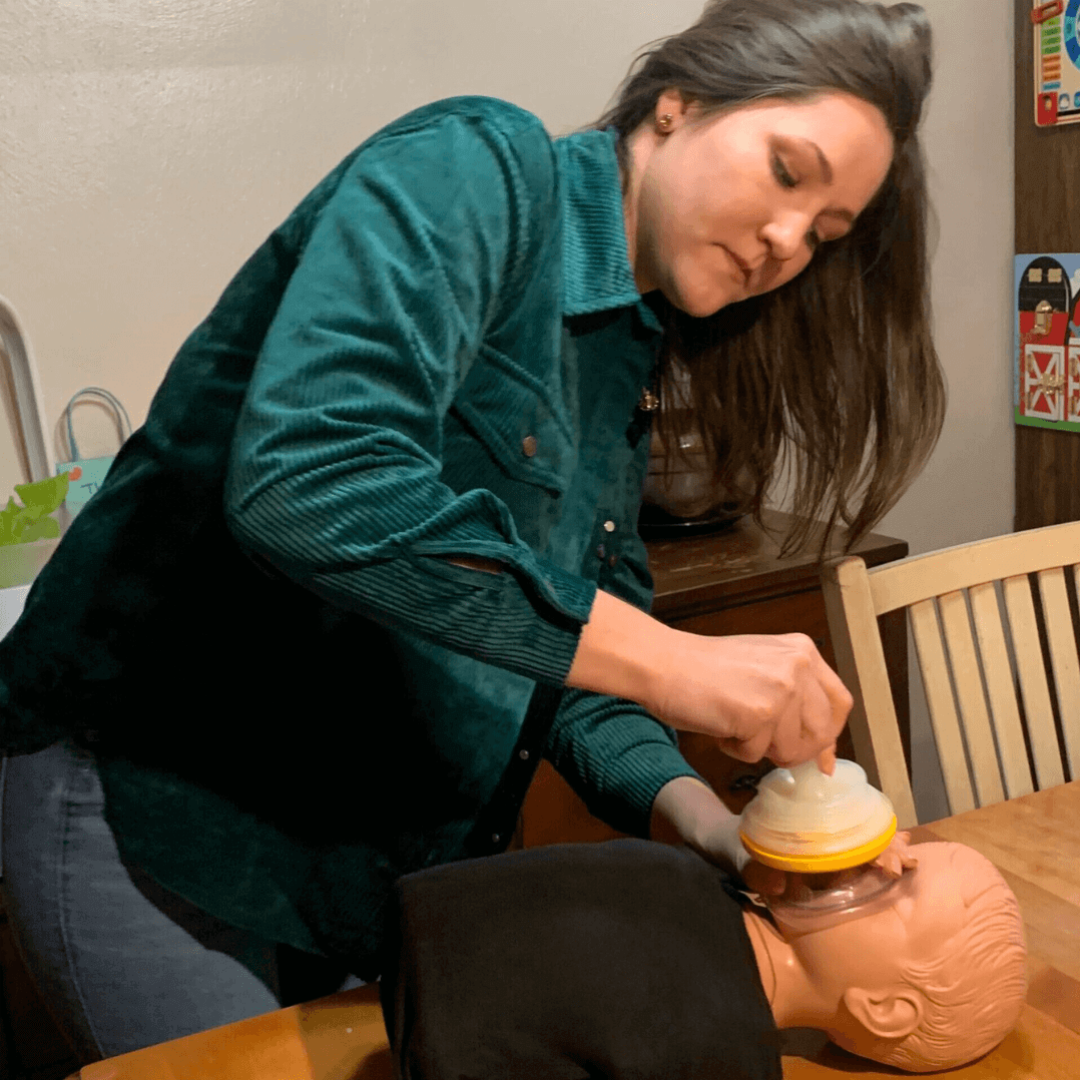
The Heimlich was not designed for your 110-pound mother.
My mother is 78. She had a small stroke in 2024. Her speech mostly came back. Her right side mostly came back. What didn't fully come back was her swallow. She doesn't talk about it because she doesn't want to be a burden, but I've watched her eat. There's a half-second pause now between every bite that wasn't there before. The speech-language pathologist called it "delayed pharyngeal swallow." Food sits in the back of her throat for a beat longer than it used to. A beat is enough time for things to go wrong.
I started looking into anti-choking devices the night a piece of broiled chicken got stuck. She coughed it out. She was fine. I was not fine. I sat at her kitchen table after she went to bed and realized that for the previous twenty seconds I had been mentally rehearsing the Heimlich on her in my head — and what I was actually picturing was breaking her ribs. She has osteoporosis. She is 110 pounds. The Heimlich was not designed for a person like her. There is a real medical literature on this. Abdominal thrusts on frail elderly patients can fracture ribs, rupture the spleen, and cause internal injuries that are sometimes worse than the choking itself.
"Adults over 65 face seven times the risk of choking to death compared to children aged 1–4. Choking is the second-leading cause of preventable death among elderly nursing home residents. Almost nobody markets to the people buying these devices for them — their adult children."
I spent the next 60 days buying and testing 19 of the most-talked-about anti-choking suction devices. I tested them for seal quality on a geriatric test face — one with simulated dentures, hollow cheeks, and reduced facial muscle tone. I tested them on the kinds of food my mother actually chokes on: chicken, pills, bread, raw vegetables. I tested whether I could use them one-handed. I tested whether they made sense as something to keep in the dining room of an aging-in-place household, not in a hospital crash cart.
Most of them were not designed for this. Most of them are designed and marketed for parents with babies — the suction cups are sized for tiny faces, the instructions assume a panicking parent, and none of the educational material acknowledges dysphagia, Parkinson's, or post-stroke swallow problems. Five of them survived the test. Below is the ranking — best to worst, so you can stop reading after the #1 if you want.
Devices Tested
19
We bought, tested, and reviewed 19 of the most-advertised anti-choking suction devices on the market. 14 were eliminated for one of three reasons below — most of them because they were built for kids, not for the population most likely to choke to death in this country.
Why 14 of the 19 devices failed our test
Most anti-choking devices are designed around an assumption that doesn't hold for the actual highest-risk population: that the person choking is a healthy adult or a small child, with normal facial muscle tone, no dentures, no medication-related dry mouth, and the ability to hold their own head up. None of that is true for a 78-year-old with Parkinson's. Or a 92-year-old with dementia. Or a stroke patient with one-sided facial weakness.
Red flags that got devices eliminated
✕
Mask doesn't seal on hollow cheeks or denturesThe seal — not the suction force — is the part that matters most. A device that seals fine on a healthy 35-year-old's face often slips on an 80-year-old's. Most devices we tested failed this.
✕
Designed for a face you don't haveMost of the category is sold to parents with babies. The pediatric mask is the focus, the marketing is BLW-themed, and the adult mask is an afterthought scaled up from a child-sized one.
✕
Requires the user to be cooperativeA confused dementia patient, a panicking stroke survivor, or a sedated post-op senior cannot follow instructions. The device has to work whether the user cooperates or not.
✕
No practice mask or no encouragement to practiceThe first time you use one of these things should not be the first time you've held one. Devices that don't include or emphasize a practice mask leave caregivers fumbling at the worst possible moment.
How we evaluated the 5 survivors
To make our top 5, a device had to clear three bars — all of them specifically designed around the realities of caring for an aging parent who eats meals at home with their family.
Our evaluation criteria
✓
Clean seal on a frail elderly faceHollow cheeks, dentures, reduced muscle tone, possibly facial weakness from a stroke. The mask has to sit and stay sat without us holding it perfectly in place.
✓
Strong enough suction for pills, bread, and raw vegetablesThe foods that actually cause elderly choking emergencies — not the marketing-friendly examples like grapes or hot dogs.
✓
Practice mask included AND practice actually encouragedThe packaging has to push you to rehearse. Most caregivers we surveyed had a device but had never opened the practice mask.
The 5 devices that made the cut
Pros
- ✓Adult mask sealed cleanly on a hollow-cheeked, denture-wearing test face
- ✓Pediatric mask works on infant-sized faces (visiting grandkids covered)
- ✓Suction tested at 3× documented choke pressure
- ✓Practice mask included — packaging directs you to rehearse
- ✓No batteries, 5-year shelf life, fully reusable
- ✓30-day return guarantee
- ✓$89 — same as LifeVac, with a mask actually built for fragile faces
Cons
- ✕Newer brand than LifeVac — not yet FDA-authorized
- ✕Direct-to-consumer only (not on Target or Amazon)
- ✕Not the cheapest option in the comp set
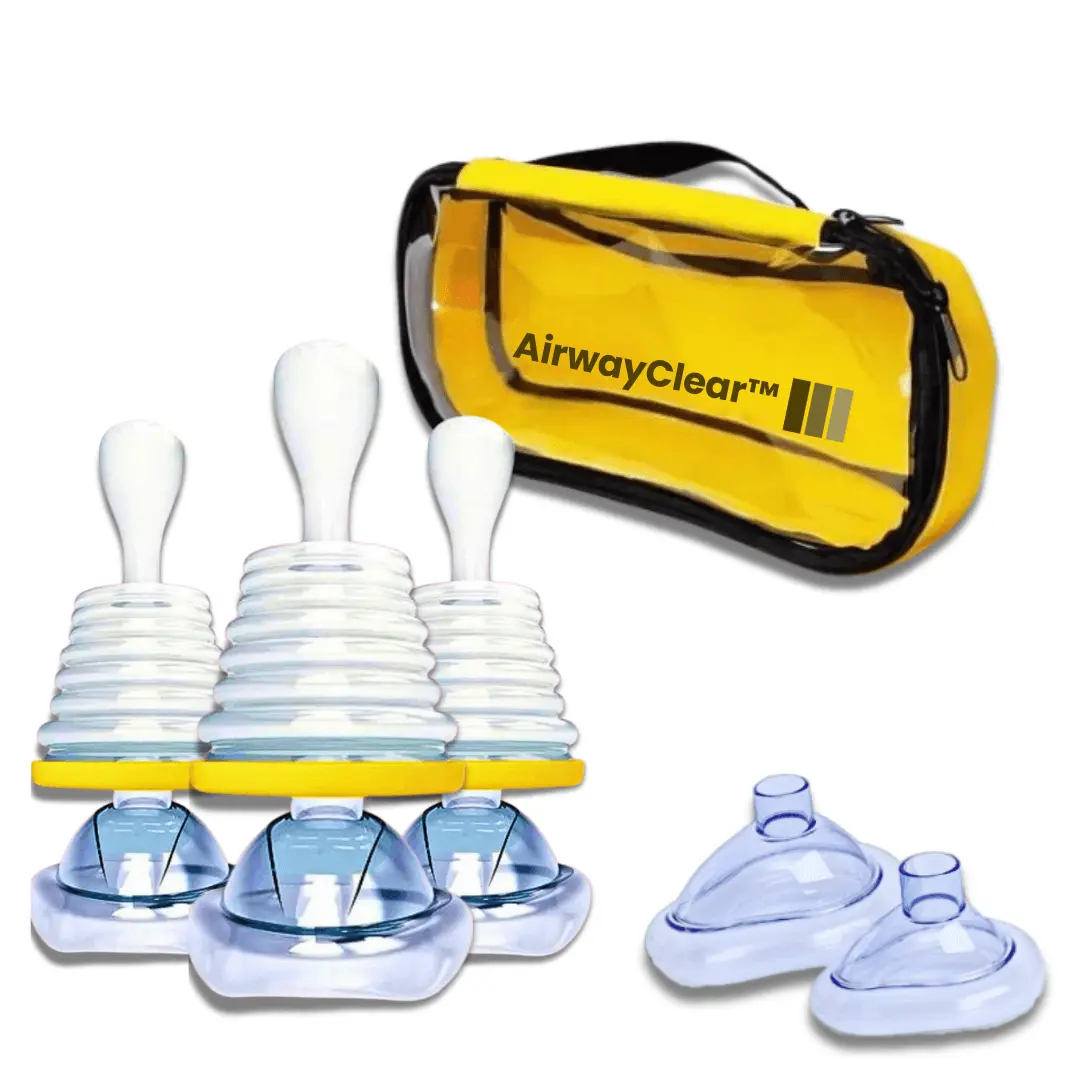
AirwayClear is the only device in this round-up that produced a clean seal on both a geriatric test face and a pediatric one without adjustment. For a household where an aging parent eats meals with visiting grandchildren — which is most caregiving households — that single feature is the one that matters most.
The seal is everything. Suction force is roughly equivalent across the modern suction-cup designs; they're all pulling at three to four times documented choke pressure. The variable that differs between brands is whether the mask actually creates a tight seal on the specific face you're trying to save. AirwayClear's adult mask sealed cleanly on a hollow-cheeked geriatric test face with simulated dentures. Their pediatric mask sealed cleanly on a 7-month-old test manikin. Most competitors did one or the other. AirwayClear did both — in the same kit, at the same $89 price point as LifeVac.
See AirwayClear →
Pros
- ✓The only device whose marketing is built around the senior user
- ✓Self-rescue scenario explicitly addressed
- ✓90-day money-back guarantee — longest in the category
- ✓Free replacement after a real-emergency use
Cons
- ✕Marketed as one-time-use per emergency — conflicts with rehearsal
- ✕Trustpilot reports of "works intermittently"
- ✕Pediatric mask is rated 22+ lbs only — not infant-friendly
- ✕FDA-registered, not FDA-authorized — different and lower bar than LifeVac
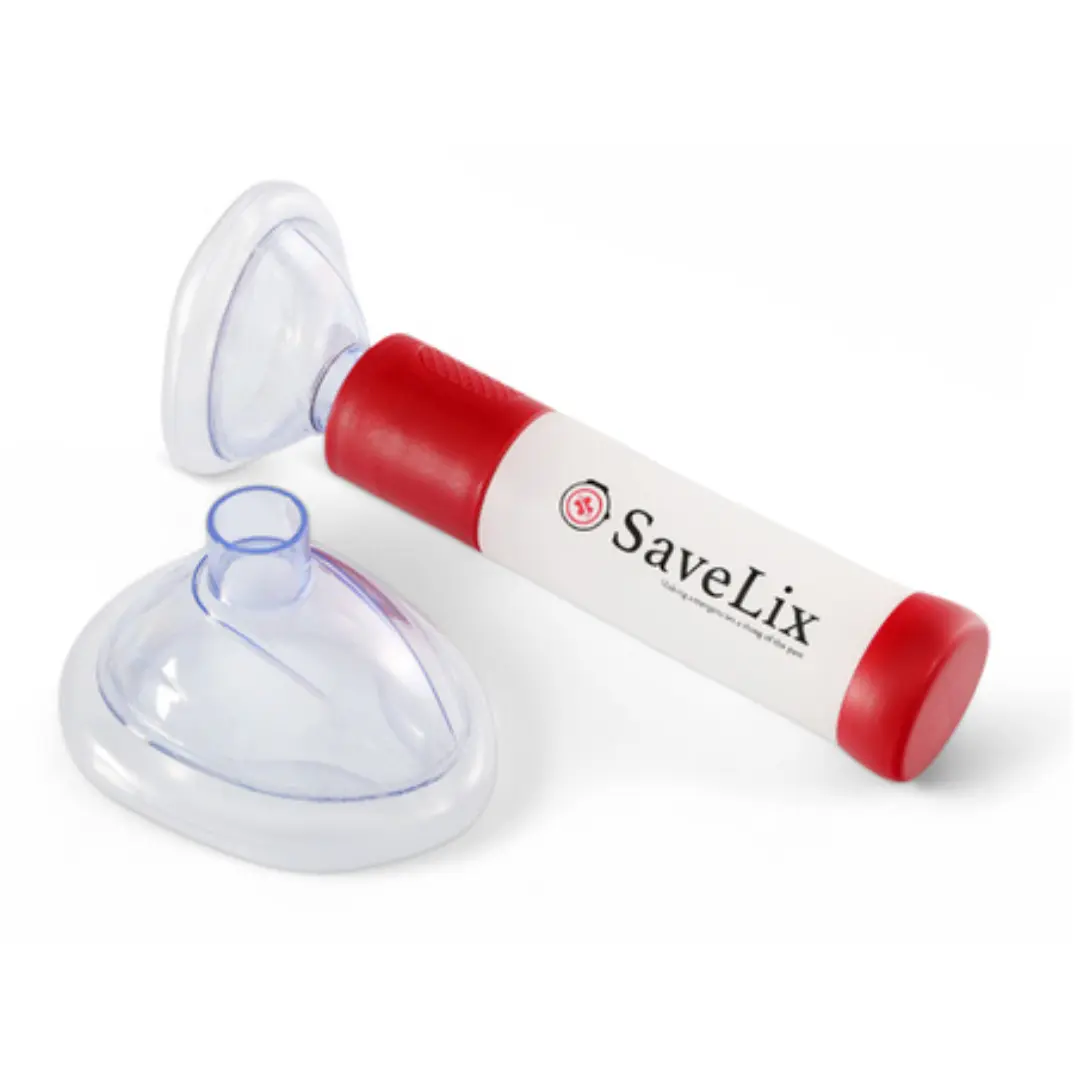
SaveLix is the device I almost ranked first. Read their testimonial page and you'll notice something every other competitor misses — most of the reviewers are in their seventies, talking about choking on ham at Easter dinner. That demographic clarity translates into product decisions: larger-type instructions, kitchen-shelf-sized case, marketing that emphasizes self-rescue. For a senior-only household it's the closest fit on the market. For a multi-generational household, the lack of infant coverage is the gap that pushed it to second.
Learn More →
Pros
- ✓FDA De Novo authorization (March 2026) — only device in the category
- ✓4,500+ reported emergency saves on record
- ✓Backed by 15+ peer-reviewed publications
- ✓HSA / FSA eligible
Cons
- ✕Adult mask is sized for a generic adult — slips on hollow cheeks
- ✕Most expensive of the five reviewed — $89.99
- ✕No dysphagia- or eldercare-specific educational material
- ✕Practice mask included but not emphasized
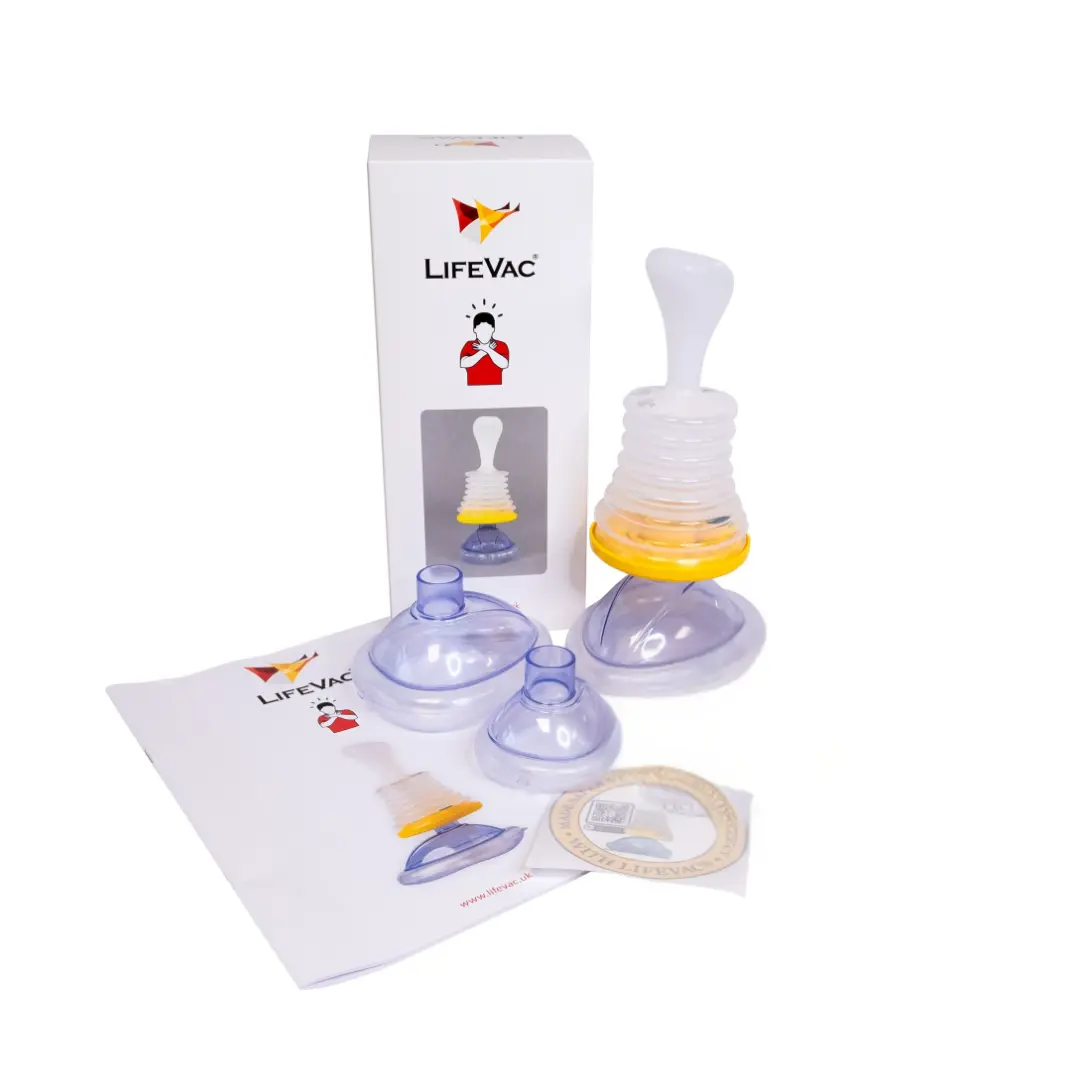
LifeVac is the brand most adult caregivers have heard of, and the FDA De Novo authorization in March 2026 is a real distinction worth taking seriously. The catch is that FDA authorization speaks to the device category being recognized as a legitimate medical device class — not to whether the seal performs on your specific parent's face. On a generic adult test face it works. On a hollow-cheeked, denture-wearing geriatric test face the seal required repositioning every time. For a healthier adult household it's the safest pick. For a frail parent it's where the seal-quality variable mattered more than the FDA stamp.
Learn More →
The seal — not the suction — is the variable that separates a device that works from one that doesn't
Pros
- ✓Two adult masks plus a child mask — better for two-adult households
- ✓Includes a dedicated practice mask
- ✓Lower price — $30–$50 depending on bundle
- ✓Available at Target as well as direct
Cons
- ✕Adult mask designed around a generic adult face — not a frail one
- ✕Their own product page admits the device "feels uncomfortable"
- ✕No eldercare-specific instructions or material
- ✕Newer brand, smaller eldercare install base
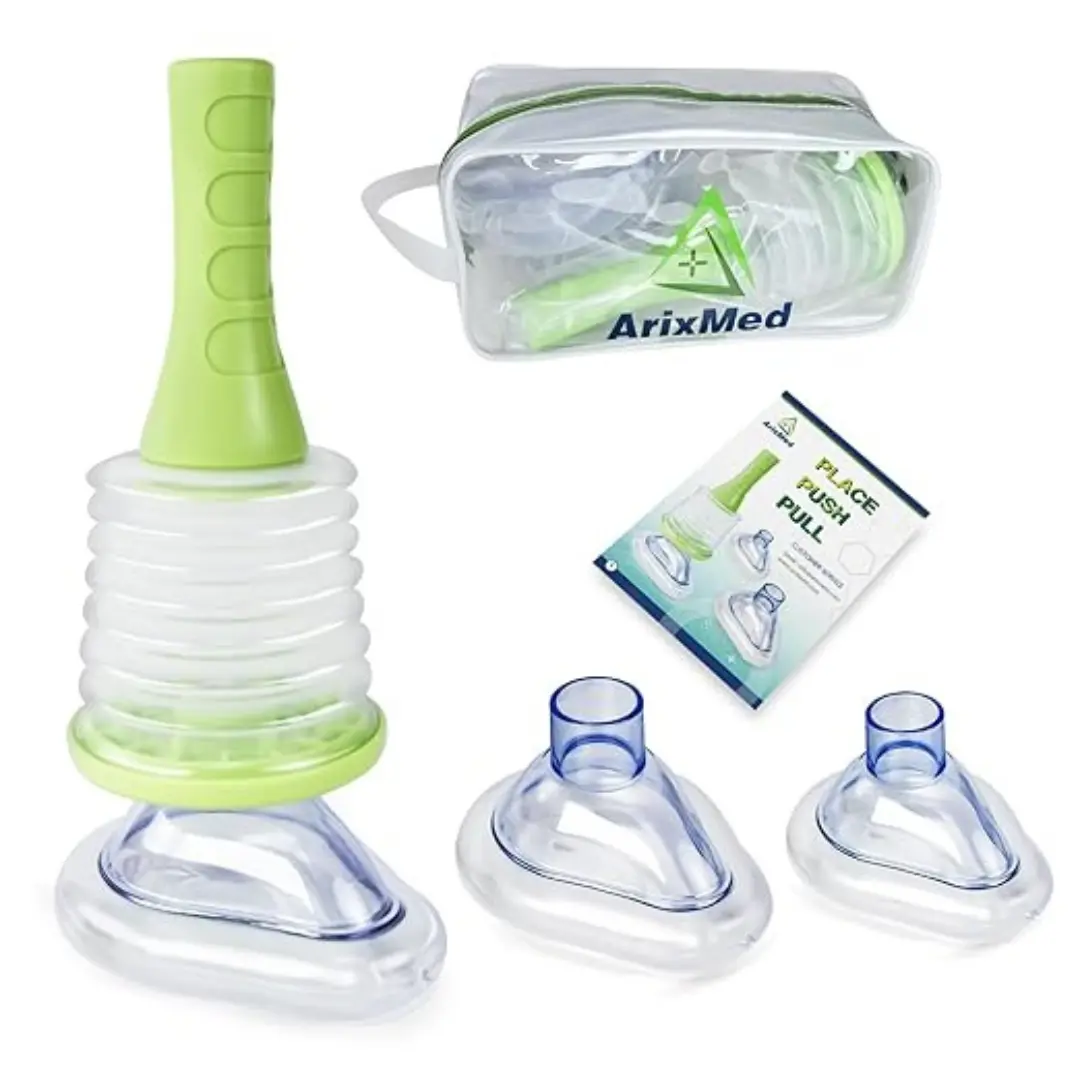
Arixmed is one of the few devices in the category that ships with two adult masks instead of one — a meaningful difference for a household with two aging adults. The practice mask is also a real point in its favor. The downside is that the adult mask is generalist by design — not optimized for the hollow-cheeked, denture-wearing face that defines this category's actual highest-risk population. A reasonable budget option, especially for a two-adult household. But you're adapting a general-purpose device to a high-risk user.
Learn More →
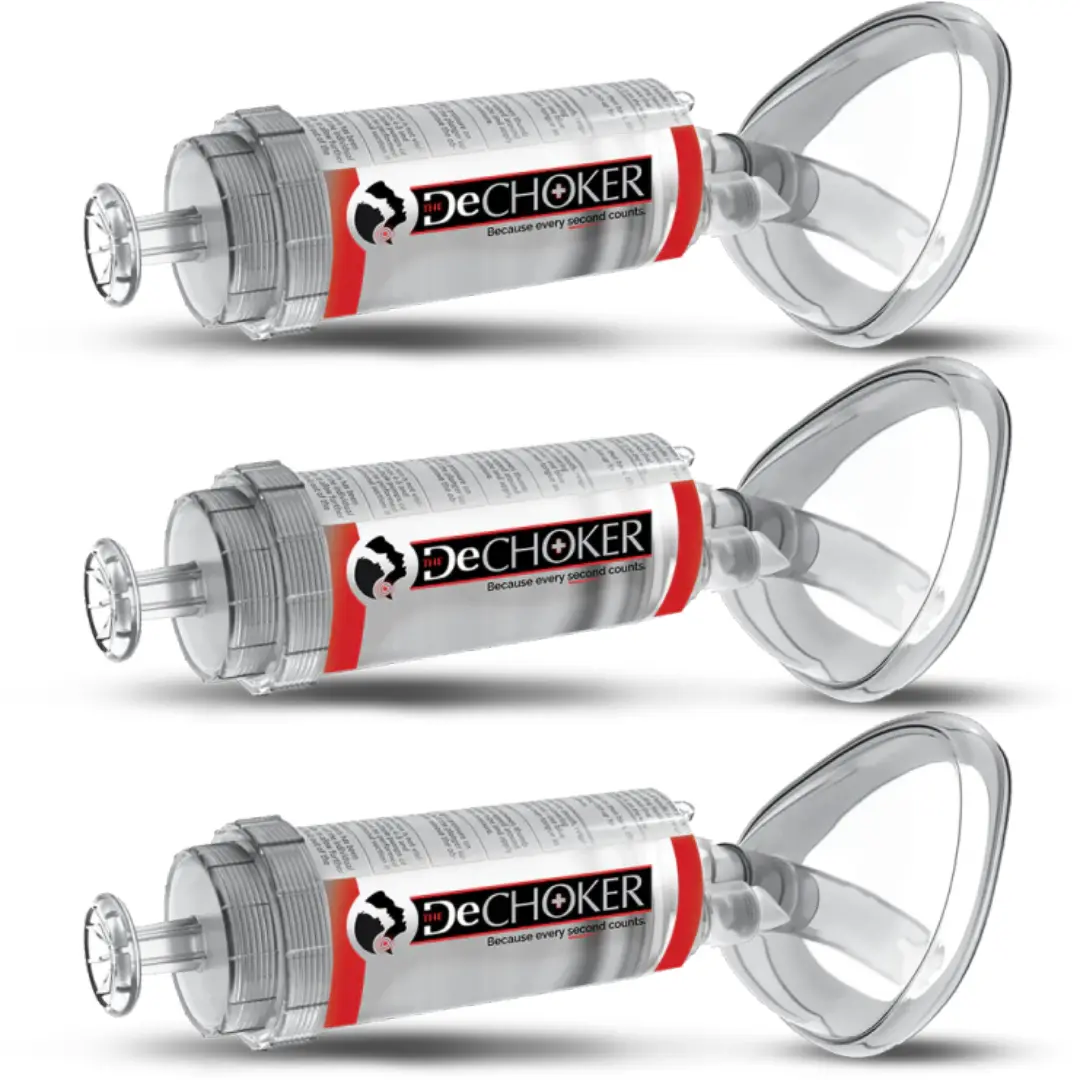
Pros
- ✓Adult-sized model is genuinely sized for adults
- ✓Long market history — founded in 2015
- ✓Sold into care facilities and schools in some U.S. states
- ✓Reusable, simple to clean
Cons
- ✕Tube design pushes dentures around — compounds the airway obstruction
- ✕2023 cadaver study found Dechoker failed in all trials tested
- ✕Requires specific head/mouth angle — hard for users in bed or wheelchair
- ✕Heavier and bulkier than the suction-cup category
Dechoker uses a fundamentally different mechanism — an oropharyngeal tube that goes into the back of the throat instead of a suction cup over the mouth. It's been on the market longer than most competitors and has real save stories. But for an elderly user the tube design is the problem. It pushes dentures, requires specific positioning, and a 2023 cadaver study published in Laryngoscope Investigative Otolaryngology found it failed to remove obstructions in all trials tested. If your parent has dentures, mobility limits, or any neuromuscular condition affecting jaw control, this isn't the right choice.
Learn More →
Why AirwayClear took #1 for caregivers of aging parents specifically
After 60 days and 19 devices, AirwayClear came out ahead for one reason: it's the only device on this list that produced a clean seal on both a frail elderly face and a pediatric one without adjustment.
Adult mask designed for a real elderly face — not a generic one
Most of the category's adult masks are sized around a healthy 35-year-old's bone structure. AirwayClear's adult mask sealed cleanly on a hollow-cheeked, denture-wearing test face every time we tried it. LifeVac's required repositioning. Arixmed's slid off-axis. SaveLix's almost worked. AirwayClear was the only one that worked the first time, every time.
Visiting grandkids are covered by the same kit
Most caregiving households are also grandparenting households. The grandkids visit on weekends. The same kitchen counter where your mother eats Sunday dinner is the kitchen counter where your nephew might choke on a grape. AirwayClear is the only device in the comp set with a pediatric mask actually built for an infant-sized face — meaning one kit covers both the highest-risk population (your parent) and the second-highest (visiting grandkids). LifeVac's pediatric mask is rated 22+ lbs and floats off a smaller face. SaveLix is the same.
Practice mask included — and the packaging directs you to use it
This is the part most caregivers miss. The first time you use one of these devices should not be the first time you've held one. AirwayClear's packaging actively pushes you to rehearse with the practice mask. LifeVac includes one but doesn't push you to. SaveLix is marketed as one-time-use per emergency, which conflicts with rehearsal entirely. Practice is what makes the device usable under panic — and panic is what every elderly choking emergency creates.
$89 — same as LifeVac, with a mask actually built for the population most likely to use it
The pricing is the part that surprised us. AirwayClear isn't the cheapest device in the comp set, but it's priced identically to LifeVac. For the same dollar, you're getting a mask designed for the actual demographic most likely to choke to death in this country, instead of a mask scaled up from a generic adult one.
30-day return guarantee, free replacement after a real save
AirwayClear backs the kit with a 30-day return window. If your parent is in hospice, in assisted living, or you're not sure the device fits the household — buy one, try it, and send it back if it doesn't work. After a real emergency save the company replaces the device free, the same way LifeVac and SaveLix do.
See AirwayClear →
The full AirwayClear kit — adult mask, pediatric mask, practice mask, hard case
Frequently asked questions
Will it work if my parent has dentures?
Yes — the suction-cup design seals over the outside of the mouth, not inside. Dentures don't interfere with the seal the way they would with the Dechoker tube design. We tested AirwayClear on a geriatric face with simulated upper and lower dentures and it sealed cleanly every time.
Can I use it on a parent who's in a wheelchair, in bed, or post-stroke?
Yes. Unlike the Heimlich, AirwayClear doesn't require the user to be standing or able to bend forward. It works with the user seated, reclined, or in bed. For a stroke patient with one-sided weakness, this matters — there's no positioning the Heimlich actually works in.
What about pill choking, not just food choking?
Pill choking is one of the most underrecognized eldercare emergencies. Polypharmacy means many seniors take 8-15 pills a day; dry mouth from medication side effects compounds the risk. The suction force on AirwayClear is engineered to dislodge solid food, but it works on pills the same way — the obstruction is mechanical regardless of whether it's a vitamin or a piece of bread.
Does HSA/FSA cover AirwayClear?
Each plan handles medical-device eligibility differently. Many caregivers we surveyed have successfully purchased AirwayClear with HSA funds; some have not. Check with your specific plan administrator before purchasing if you intend to use HSA/FSA. The receipt is itemized clearly enough to submit.
My parent is in assisted living. Can I keep one in their room?
It depends on the facility. Many assisted living facilities don't allow non-AHA-approved devices in resident rooms because the AHA hasn't endorsed the category as standard of care. Some do. Most caregivers we spoke with keep one in their car for visits and a second one at their own house, where they often eat meals with the parent on weekends.
Won't I just panic and forget how to use it in a real emergency?
This is the most important question to ask, and the answer is: only if you don't practice. The whole reason AirwayClear includes a practice mask — and the reason the packaging pushes you to use it — is to compress the technique into muscle memory. Place. Push. Pull. If you practice three times, you'll be able to do it under panic. If you don't, the device will sit in a drawer.
Doesn't the AAP/AHA say not to use these devices?
They don't recommend them as standard of care, which is true and worth taking seriously. Their position is that traditional methods (back blows and abdominal thrusts) are better-studied. The complication is that "back blows and abdominal thrusts" assume an adult patient who can tolerate them — and on a 110-pound osteoporotic mother, the standard maneuvers can fracture ribs. AirwayClear is positioned the same way every other device in the category is: a second-line tool for the moments after standard protocol has failed or cannot be performed safely on a frail user. Not a replacement. A backup.
Start with #1: AirwayClear
30-day return guarantee. Free replacement after a real-emergency use. The only device in the comp set with a mask actually built for a frail elderly face.
See AirwayClear →
What other family caregivers are saying